Home / The Dinosaurs
The Dinosaurs
The gallery from the man who mounted the bones — and which skeleton is holding a secret in its tail.
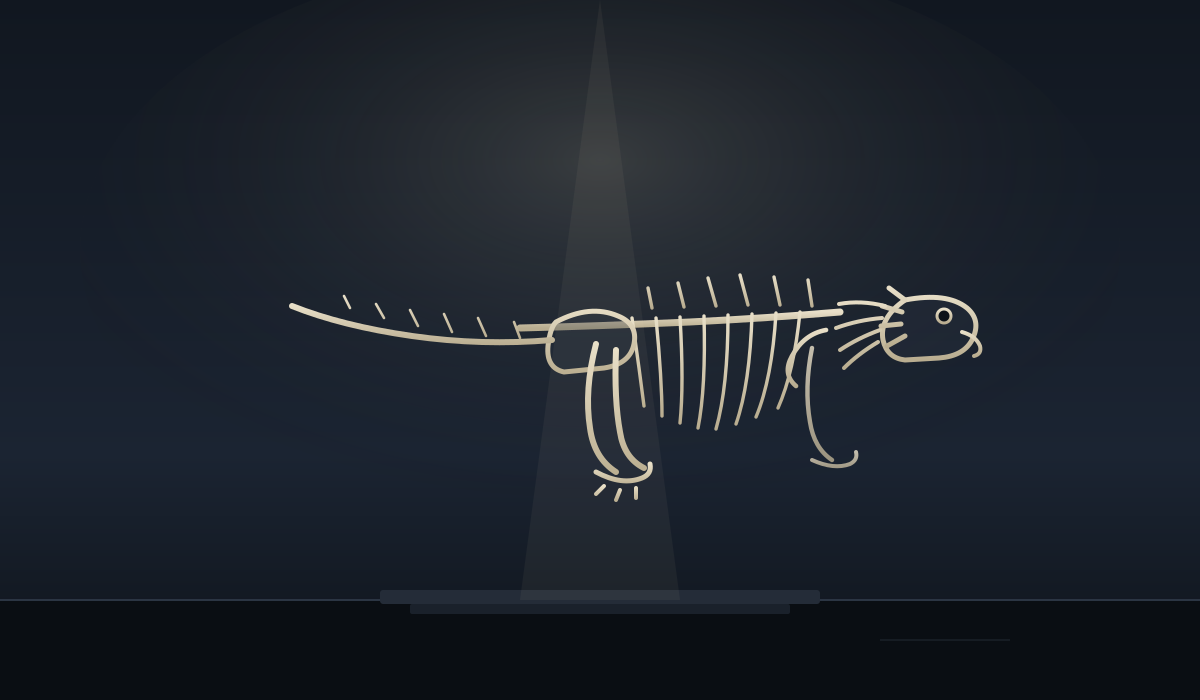
What you're actually looking at
The dinosaur gallery on the second floor is the one everybody comes for, and it earns it. The big mount in the centre hall is a barosaurus — a long-necked plant-eater that stood about four storeys when it was alive. If you want the dry encyclopaedia version, the Wikipedia entry is accurate enough; it will tell you it lived in the Late Jurassic and ate conifers. It won't tell you that the mount in front of you is roughly sixty percent real fossil and forty percent cast.
That ratio is normal. Nobody mounts a hundred percent real bone on a free-standing armature; the weight alone would crack it, and the insurance people would have a fit. The skull on this one is a cast. The real skull is in a drawer in the collections room on the lower level, because the original was crushed flat and nobody wanted to risk it on a public mount. If you ever wondered why the head looks slightly off from certain angles — that's why. It's a cast of a squashed skull, straightened out by a very patient person with a lot of epoxy and a dental pick.
The tail collar
In 2013 we re-mounted the tail. The old armature had a resonance problem: every time a school group ran past, the last four vertebrae would pick up the vibration and hum. Faintly, but you could hear it if you stood close. Drove the guards mad for nine years. I solved it with a brass collar at the third joint — a two-piece clamp with a rubber gasket inside, machined by a guy named Pavel who worked in the buildings shop and never once complained about my sketches. If you look at the base of the tail where it meets the armature, that's it. It still hums a little on a busy Saturday, but you have to put your ear against the glass.
A mounted skeleton is not a sculpture. It's a compromise between what the animal was and what steel will hold.
Which skeleton has a secret
The hadrosaur in the east corner — the duck-billed one standing on its hind legs — has a secret in its tail. When we re-mounted it in 2014 we found a healed fracture in the eleventh caudal vertebra. That animal broke its tail as a juvenile and lived another decade. You can't see the break from the rope line. You can see it if you get low and look up under the tail, which the guards will politely ask you not to do.
I've told maybe forty people about that fracture over the years. Two of them were palaeontologists who didn't know. One was a nine-year-old girl who then explained it to her entire class, loudly, in the gift shop.
What to look for if you have ten minutes
- The feet. Look at how the toes sit on the base. Every toe is on its own adjustable pad — that's how we levelled the mount after the floor settled in 2016.
- The rib cage. Count the ribs on one side. If they look uneven, that's a real asymmetry in the fossil, not a mistake by the crew. We argued about whether to correct it and decided not to.
- The shadow on the wall behind the neck. The lighting rig is set so the shadow reads as a second silhouette. That was deliberate. We argued about that for a week too, and I lost.
- The floor. The dark stone panels in front of the mount are newer than the ones at the back. We replaced them in 2017 because the originals had worn shiny where two million children had slid on them.
Kids and the gallery
It's the loudest room in the building on a Saturday. There are touch screens, there's a fossil dig pit with rubber gravel, and there is at least one animatronic that makes a noise like a dropped filing cabinet. If your child is sound-sensitive, go on a Tuesday morning and skip the animatronic alcove on the north side. The staff know it's loud; they'll point you around it if you ask.
My own grandson was terrified of the animatronic until he was six. Then he decided it was his favourite thing in the building and we had to visit it four times in one afternoon. Children are like that.
If you only have twenty minutes
Go straight to the main mount, walk a full circle around it, then look up at the ceiling above the neck. The lighting rig hangs from a truss that was installed in 2007 and has been adjusted eleven times since. Then leave. Twenty minutes is enough to see the thing that matters, and it's better than rushing the whole floor and remembering none of it.
Timed tickets for the museum are sold by the museum itself — their site is here. I don't sell them, don't hold them, and don't get a cut. If somebody offers you "dinosaur gallery skip-the-line" tickets on another site, that's not a thing — there's no separate dinosaur ticket.